Glass is fragile. Glass breaks. But glass survives somehow. A wooden box of old glass slides has survived and come my way.
Some slides are cracked. Some are broken, but many are intact. They date from the early 1930s when the Youth Hostels Association (YHA) used slides like these for publicity purposes, at magic lantern shows, in halls and clubhouses, promoting holidays for young people in its hostels.
A torn corner of the organisation’s familiar green logo is just visible on the cover of the wooden box. A lined page inside the box lists the slides and their subjects.
Some are of places rarely seen before. They include shots of the Damson Dene hostel at Crosthwaite, near Kendal, Cumbria. That one was open from 1931-1963.
Some are of hostels not seen before, like the hostel at Askrigg in Yorkshire, open 1934-1950. A couple are rare shots of the early Coniston Coppermines hostel, surrounded by mineworkings.
Some show the interiors of hostels. From them we can glimpse the conditions of early youth hostel holidays.
One shows the common room at Goldrill House, Patterdale, complete with oil lamp. Another of the common room at Keswick shows what looks like a hotel lounge, which it was when YHA took the hostel in 1933.
Many have been seen before, like a collection of shots of Black Sail. Some have been used in publicity shots and on postcards, sold to raise funds for early hostels.
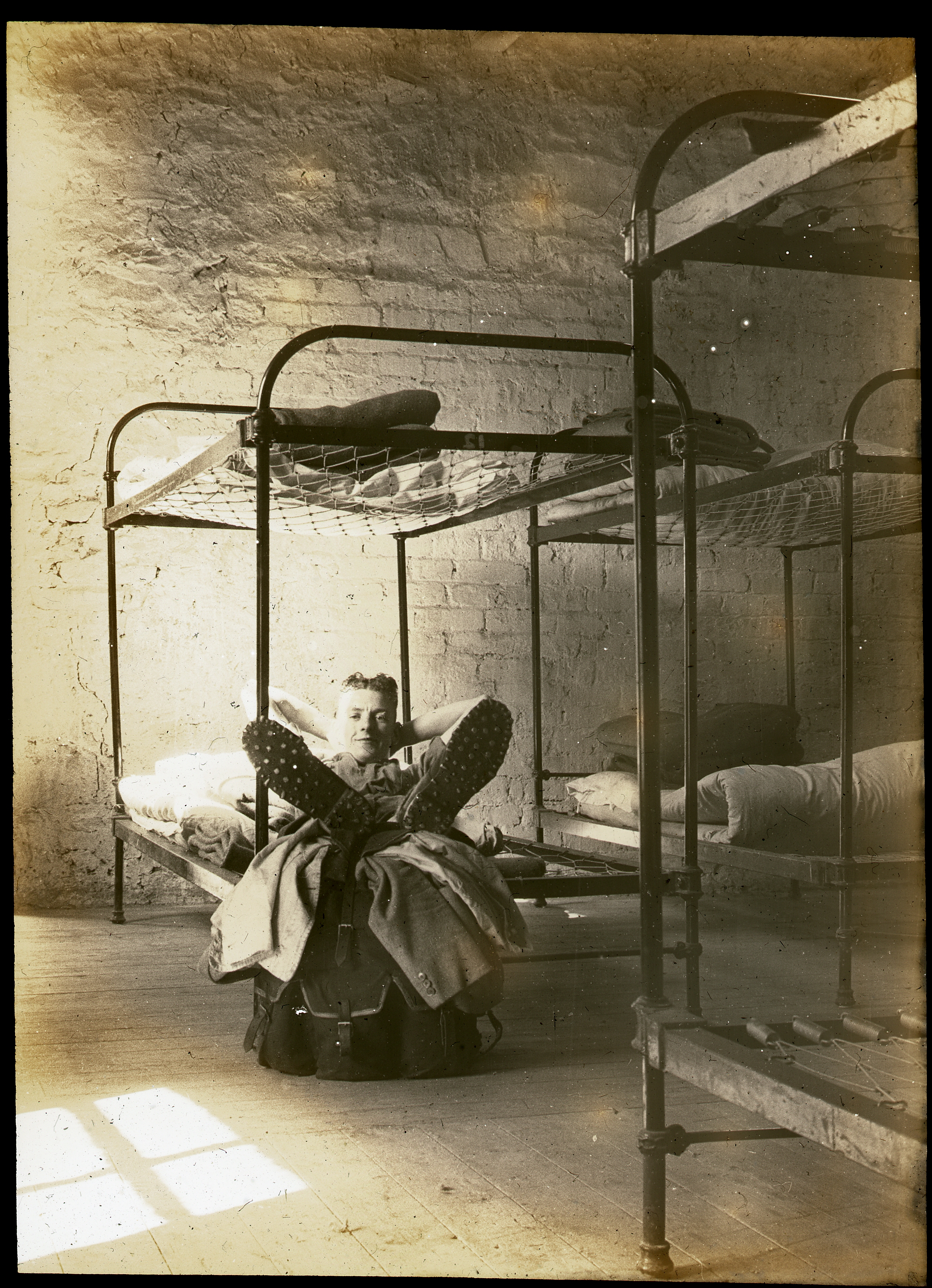
One shows a young man with a smile, lounging on a wire meshed bed, his hobnail boots on display. At the end of a long day walking, he beams his pleasure, glad to have found a bed and happy to have his photo taken.
But the large boots and their nails are an unforgettable reminder of walking equipment in those days. There’s even a photo of a Christmas crowd enjoying the seasonal festivities at Black Sail hut.
Each slide, shows the resilience of old fashioned, out of date records. Found in a cellar years ago, all that glass survived.
Perhaps because the box that contained them was heavy, solid and handmade, they’ve survived. It weighs in at nearly 8lbs. Today our records are lighter. They’re carried with ease, unlike that bulky box. But there’s no way of knowing whether any of them will survive in anything like the condition of these slides.
The records on which histories rest are often fragile but, like these slides, they do endure. Volunteers hunt them out. Enthusiasts hang on to them for the future, and some turn up in family attics, in lofts and cellars. They’re fundamental in the preservtion history.
Soon the slides and their box will be on their way to the YHA archive at the Cadbury Research Library, University of Birmingham. There they will be stored, snug in their wooden box with the carefully written list that accompanies them.
A record of happy times, and holidays from the 1930s will survive, illustrating the beginnings of mass tourism for many young people and the simple conditions in which it thrived.
They’ll be reminders that the origins of our holidays were very unlike today’s holidays. They’ll show that holidays can be simple, close to home, and fun.


Leave a Reply