Reflections on diaries and blogs. Their difference today shows how tourism has changed.
Sun, rain and people
In the 1930s young people kept records of their journeys. We know about their journeys, the places they stayed and the people they met. In many ways their journeys are very much the same as ours today.
We know that rain drenched them. The sun burned them. We know they made friends, enjoyed food and saw new places. Their journeys gave them a bug for travel so that they carried on touring into their later lives.
At least one of them went on tours for the rest of her life and left a stack of accounts of all the journeys she took. Hers are in the Cadbury Research Library at the University of Birmingham.
Comical and tiny
They wrote their diaries each night, by candlelight or lamplight. Some wrote them later, when they were home, and when their travels had ended.
Along the way, they took photos. They bought postcards. They glued those into their journals and diaries. They adorned pages with hand drawn maps, and lists of the places where they had had stayed. One embellished hers with tiny, comical drawings.
From those diaries a social history of tourism emerges. From at least four of those, we know about the experience of young women in the 1930s, as they toured Britain.
Blisters and sun burn
We know about the places they stayed. We know about youth hostels, about the beds they slept in, the food they ate, and the company they kept, while they travelled.
We know about the heat, the rain and the cold. We know about their blisters, sunburn and occasional illnesses.
We know about the way society and men interracted with them, and we know a little about the economics of their journeys.
Further, faster
It’s not much different today. Travellers still keep journals. They record their joys, talk about the fridnes they meet, and the places they visit. But the journals we see are not on paper. They are not handwritten in pen and ink, with small humorous illustrations. Their maps are not hand-drawn.
The journals of today are found on-line. They are blogs, and there are many kinds, endless lists of them.
Blogs show that travel has not changed. Despite techonology, jets, and further, faster travel, tourists are the same now as they were then. They still record their travels. They retain records of their travels. They still express their joy and happiness on holiday.
Life’s a stage
But there is at least one difference. At least one. The travellers of 1930 wrote diaries for themselves. They may have shared what they wrote, much later, when they were home. They may have let others read what they had written, but I doubt it.
Their diaries read as very private accounts. I suspect they were written with no audience in mind.
Writing today is different. Writing today is public. It’s created to be shared. Blogs are made to be seen by others, by strangers and friends. Journeys are shown, seen and observed.
Unpapered
Our lives are public. We’ve professionalised our private lives. Travellers live on a stage that was not there one hundred years ago.
That’s the big difference in our travels. We travel to be seen. We travel to share in a public way that was not there one hundred years ago.
There are other differences, I’m sure, but the public nature of our travel is a big and crucial difference. The diaries of the 1930s illustrate that difference with perfection.
Notes
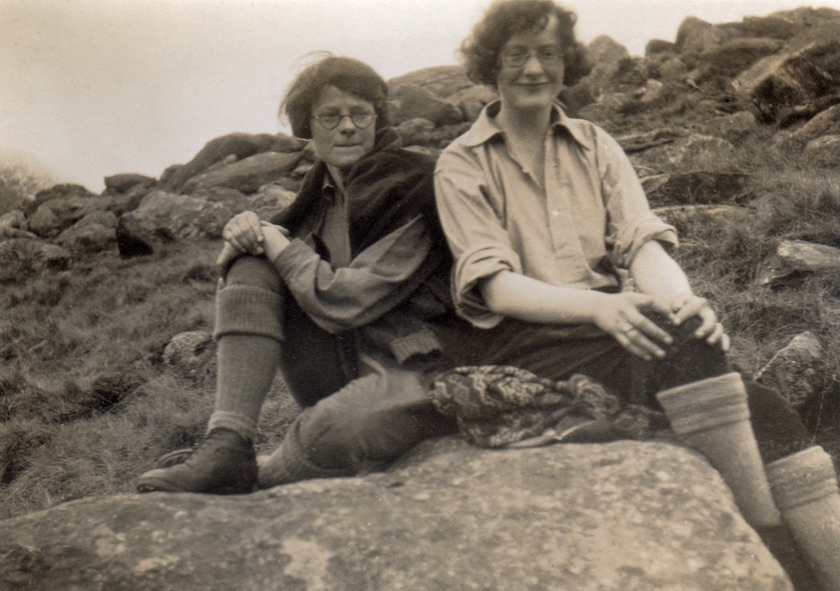
Image above shows Berta Gough (left). Her diaries give an unmatched account of the early history of youth hostels from a personal point of view.
Photo of Berta with Ena Fairclough on the Glyders, c1930, courtesy Gillian Hutchison / YHA archive, Cadbury Research Library, University of Birmingham.
The diaries of Hilary Hughes are in the Cadbury Research Library at the University of Birmingham. Those of Isobel Brown, her sister, and friends are in the Scottish National Library, Edinburgh.
Without the efforts of family and friends, many diaries and logbooks would have been lost. I’m always indebted to John Martin, YHA’s volunteer archivisit, for his painstaking efforts to retain those and other records. Those might have been lost if not for John’s work.
 SIMPLY HOSTELS
Leave a comment