Global travel and youth hostels in 1936
Franz was Dutch. He rode a massive weighty bike all hung about with gadgets. He was in England for a fortnight in 1936. He had been to London, the Lake District, and Stratford-on-Avon. He did it all without a map. He took his directions from road signs, and people he met along the way.
Others foot slogged. An American went over the Snake Pass in Derbyshire in rain and mist and walked with three young women on their way to Glossop. They were among many visitors headed to youth hostels in Britain in 1936. They came from Europe, and from “overseas”.
In youth hostels they joined a lively community which formed in common rooms and youth hostel kitchens each night.
Around the world
At their heart, youth hostels were international. Begun in Germany, the idea had spread first to Switzerland, then Poland, the Netherlands, and Norway. After Britain and Ireland, France and Belgium embraced them too.
Visitors from other countries spent 36,022 nights in English and Welsh youth hostels in 1936. They were 9% of the total stays that year. The most came from “foreign” Scotland. 6,541 came from the USA, next most after Scotland.
More came from Europe. Germans, Dutch, Danes, Belgians, Austrians, Norwegians, Poles, French, Swiss and Czechs. They came from Ireland (Northern) and Ireland (the Irish Free State). The British empire still ruled. Colonials added numbers and those from the Dominions.
Destinations
The Lake District was their most popular destination. 21% of them went to Lakeland. More than 6,000 went to London. They went to Devon, Cornwall, Gloucester, Somerset, and North Wales. They went to Stratford, Oxford and Cambridge too. They went to the south coast of England.
YHA members from England and Wales went to Europe. We have no numbers for how many or where they went.
Germany was popular, popular enough that youth hostels stepped in after the Nazi government limited travel abroad. It restricted foreign currency. Youth hostels began their own exchange. They sold coupons valid in the other country’s hostels. A balance ensured no actual money passed between Germany and Britain. The exchange avoided Nazi regulations and kept travel going between the two countries.
Welcoming
Youth hostels encouraged travel in other ways. Their handbook advised “more than 4,000 hostels on the Continent and in other parts of the world” welcomed visitors from England and Wales. They would meet “little difficulty in making a Rucksack journey on the Continent even if a member has little or no knowledge of any foreign language. At each hostel there is almost certain to be someone who is willing to translate.”
The handbook thought language was an adventure. Optimism would helped. Patience and good humour would overcome all difficulties.
The youth hostel handbook had a “glossary of useful foreign words” in German, French, and Norwegian. It included words like knife, fork, spoon, and telephone. It translated terms like youth hostel, dormitory and sleeping bag.
Low cost
YHA arranged discounted fares too, for crossing the sea, to Flushing, Antwerp, Rotterdam, Zeebrugge, Esbjerg and Hamburg. Members could travel First or Second class. They could travel saloon or steerage but steerage was not for women
“Females are not conveyed in the steerage”. Bookings for the overnight route to Esbjerg “should be made well in advance” because demand for it was heavy.
But cheap travel, crossings and trains had a greater purpose. Youth hostels had ideals and ambitions. They dreamed of peace and world wide understanding. They looked to tolerance, peace and justice. They dreamed of encounters in youth hostels linking nations.
Fear and suspicion
The British Prime Minister, Stanley Baldwin, wrote how youth hostels brought “young people of all different countries together, to learn to know foreign lands, foreign people, their customs…” [4] It was a time of prejudice and panic.
The world was “full of fear, suspicion and doubt.” [5] But youth hostels offered hope. “To go simply as a wanderer from one country to another… talking, trying to understand and sympathise – that is perhaps the greatest contribution to world peace that an individual can make.”
I add my hope to Baldwin’s. Today our lives are more private than theirs were then. Our suspicions and fears have spread to tourism itself. Many seem to bellieve tourism harms our communities and lives. But it can benefit us all, as youth hostels did between two world wars.
Notes.
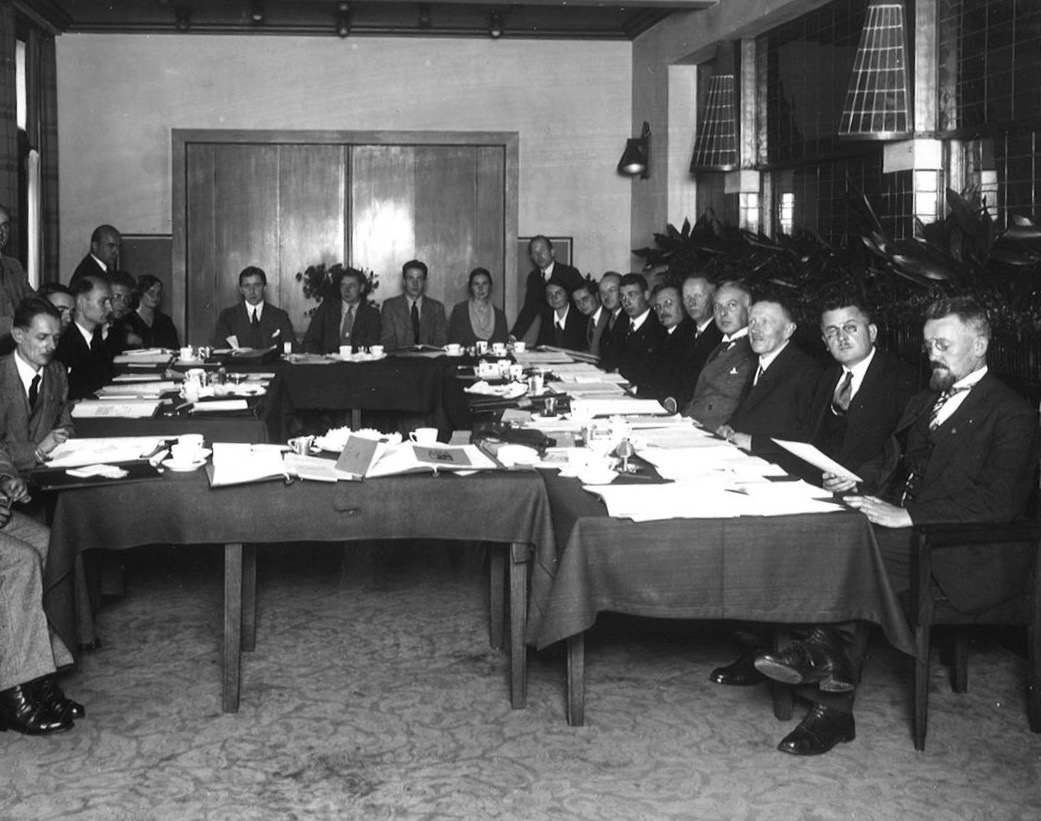
Image of the first international youth hostel conference in Amsterdam, 1932.
All quotes from the YHA handbook of 1936 and statistics from the YHA Annual Report of that year.
 SIMPLY HOSTELS
Leave a comment