How war shaped holidays after 1939.
The second in a series of four posts looking at how war shaped holidays after 1939. The experience of people captured in records, diaries and journals confounds my perceptions of well known events, like the 1939-45 war.
War didn’t stop travel in 1940. Youth hostels survived the year despite difficulties, despite rationing and requisitioning.
Wholesome opportunities
War made holidays difficult but youth hostels still recorded 275,000 overnight stays that year, a little more than half of the previous year. War didn’t stop holidays or touring and, the following year, the government made a remarkable turnaround.
The Government recognised the need for holidays even during the war, for weary workers at least. The Ministry of Labour and National Service, and the Board of Education told YHA they wanted “accommodation of the youth hostel type to be available during the summer… “.
The Board was “anxious to encourage … opportunities for young people, after they have left school, to take part in wholesome out-door recreation…”
Boosted
The Ministry of Labour echoed the Board. The Minister was “most anxious that all possible provision” was made for the needs of young industrial workers “during the coming summer months.”
War had not stopped holidays and now, with governmnt encouragement, war boosted them. A few requisitioned hostels came back to use. Others were safeguarded from requisitioning.
Geoff Smith was not there to benefit. The RAF had taken him as wireless mechanic and he went around the country fitting up new ground stations. He considered himself fortunate. He was in a unit that travelled extensively. Very occasionally with a few days leave he got away to a hostel.
Rescued
As soon as they could, two friends went north over the Pennines to the Lake District just before Easter 1941. They stayed in Grasmere, Coniston, Wasdale, Borrowdale and Keswick.
Food at times was hard to find but they managed, and once bought eggs, milk and home made bread from a farm. They ate a vegetable hotch potch, a mess of potatoes, swede, turnip and carrot, cheap and filling. They ate a lot of porridge and became expert at making it lump-free.
They walked for miles. They used the Baddeley guidebook but lost their way, in snow above Langdale, and on Helvellyn. They over estimated the distances they could walk and only reached Wasdale from Coniston because a coach driver rescued them.
Busy and full
The hostels were busy and overcrowded, a contradiction of the conventional picture of war time Britain. With Easter coming, because they couldn’t find a hostel with room for them, they went over to Yorkshire, to Teesdale, and then York.
War didn’t stop others. A young woman and her sister toured for eight days, around Loch Lomond to Loch Eck and back through Crianlarich to home in St Andrews in 1941.
Hostels were full, so full that at Loch Eck the pair shared a bed with a blanket each. Two slept in almost every bed, and the floors of each dormitory were packed solid. They enjoyed sing-songs and, at Loch Eck, a dance.
Boiling hot
Sometimes food was hard to get but they had tinned food in reserve, brought from home. They subsisted on lunches of chocolate, biscuits and, once, crisps. They queued to buy sweets at exorbitant prices.
War didn’t stop another young woman, newly married with her husband away in Egypt at war, She got away from Sheffield for five nights in the Lake District, also in 1941, staying at Keswick, Grange and Grasmere.
The weather was perfect, boiling hot, and she burned brown. People in those days enjoyed being burned brown by the sun. With blue skies, beautiful peaks and silvery lakes, she could almost have been in Switzerland.
She booked meals at hostels and the food was not bad, but it was all bulk and starch. She also had a number of good plain teas, of homemade bread and jam, home made scones and cakes. She escaped the war for a time.
It you’re interested in the history of youth hostels, there’s more in Open To All, how youth hostels changed the world. Available in paperback and digital editions. https://duncanmsimpsonwriting.com/2017/08/17/books-about-youth-hostels/
This is one of a series examining holidays in wartime. Thin bread and grumbles follows
Note on sources
Diaries and collections consulted:
Hilary Hughes logbooks Cadbury Research Libary
Olga Mowarth letters Cadbury Research Libary
Isobel and Mary Brown journals, National Records of Scotland
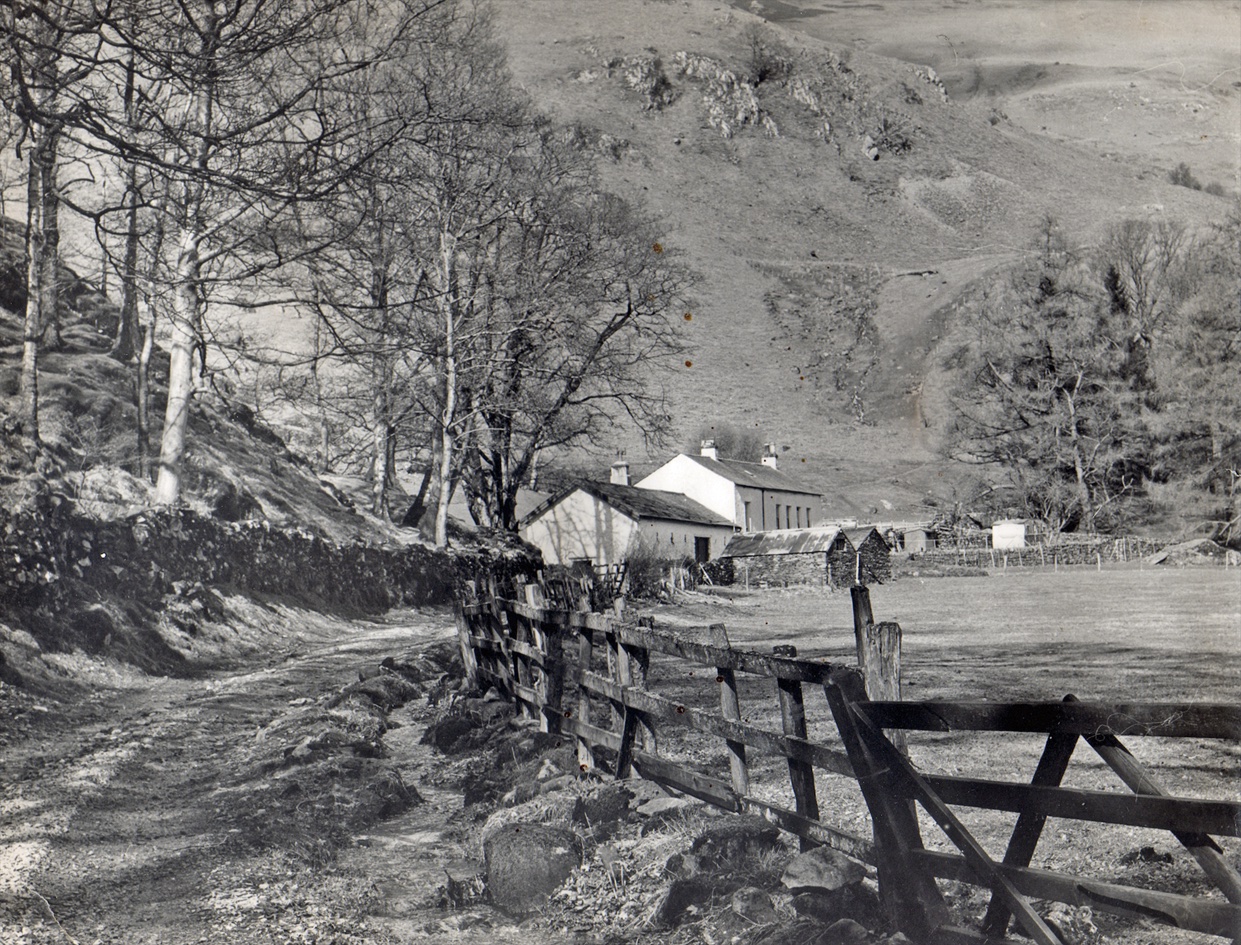
Image: Grange in Borrowdale, one of the hostels in use during the war. Y050001-Grange 02 300-8 phoY.tif
 SIMPLY HOSTELS
Leave a comment